

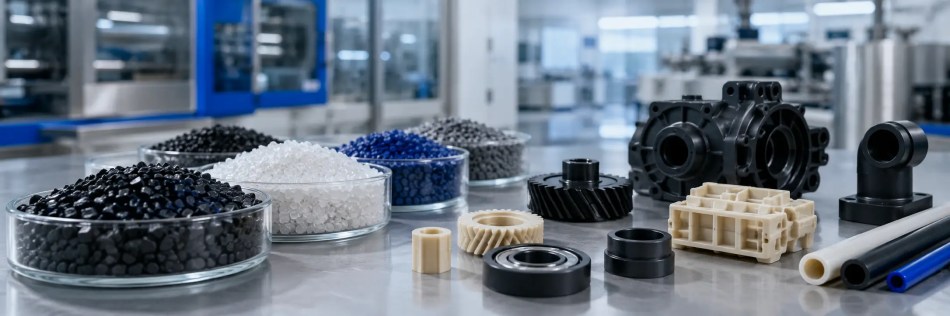
Engineering Polymer Materials for Demanding Applications
Trimline Polymers offers a focused range of engineering polymer materials used in applications where strength, dimensional stability, heat resistance, chemical resistance, and reliable processing performance are important.
Get a QuoteOur Engineering Polymer Range
Select a material below to view key details, common applications, and general processing use.

POM – Polyoxymethylene
POM, also known as acetal, is an engineering thermoplastic valued for high stiffness, low friction, good wear resistance, and strong dimensional stability. It is commonly used where parts need to move smoothly and maintain shape under regular mechanical use.
- Suitable for gears, bushings, rollers, fasteners, and precision components
- Good fatigue resistance and low moisture absorption
- Used in automotive, electrical, appliance, and industrial parts

NYLON – Polyamide
Nylon is a strong and tough engineering polymer known for good mechanical strength, abrasion resistance, and fatigue performance. It is widely used in parts that require durability under repeated movement or load.
- Suitable for gears, bearings, cable ties, housings, and industrial parts
- Good wear resistance and toughness
- Available in different polyamide types depending on application needs

ABS – Acrylonitrile Butadiene Styrene
ABS is a versatile engineering plastic offering a practical balance of toughness, rigidity, surface finish, and ease of processing. It is commonly used for molded parts where appearance and impact strength both matter.
- Used in automotive parts, appliance housings, toys, and consumer products
- Good impact strength and smooth surface finish
- Suitable for injection molding and selected extrusion applications

PC – Polycarbonate
Polycarbonate is a transparent engineering polymer known for high impact resistance, clarity, and good heat performance. It is used where strength and visual transparency are both important.
- Suitable for lenses, covers, electrical parts, sheets, and protective components
- Excellent impact strength and good dimensional stability
- Used in automotive, electronics, safety, and industrial applications

PPS – Polyphenylene Sulfide
PPS is a high-performance engineering polymer known for heat resistance, chemical resistance, dimensional stability, and low moisture absorption. It is often selected for demanding electrical, automotive, and industrial applications.
- Suitable for connectors, pump parts, valve components, and under-hood parts
- Good resistance to many chemicals and high-temperature environments
- Often used in filled or reinforced grades for improved strength

High-Temperature Engineering Polymers
PPS, PESU, and PSU are used where standard plastics may not provide enough heat resistance, dimensional stability, or long-term performance. These materials are commonly reviewed for demanding industrial, electrical, medical, and fluid-handling applications.
- PESU and PSU offer good heat resistance and hydrolytic stability
- PPS offers strong chemical and thermal performance
- Suitable selection depends on temperature, chemical exposure, and part design

TPU – Thermoplastic Polyurethane
TPU is a flexible engineering material known for elasticity, abrasion resistance, toughness, and good surface feel. It is used where rubber-like flexibility is required with thermoplastic processing.
- Used in footwear, films, hoses, cable jackets, wheels, and flexible parts
- Good abrasion resistance and flexibility
- Available in different hardness levels depending on application

SAN – Styrene Acrylonitrile
SAN is a clear and rigid styrenic polymer with good transparency, surface gloss, and chemical resistance compared with general polystyrene. It is used in applications where clarity and stiffness are required.
- Suitable for cosmetic packaging, housewares, appliance parts, and clear molded items
- Good clarity, gloss, and dimensional stability
- Commonly processed by injection molding and extrusion

PBT – Polybutylene Terephthalate
PBT is an engineering polyester known for good dimensional stability, electrical properties, chemical resistance, and fast molding performance. It is commonly used in electrical and automotive components.
- Suitable for connectors, housings, switches, sensors, and automotive parts
- Good electrical insulation and chemical resistance
- Often supplied in reinforced grades for improved stiffness and strength
Common Application Areas
Engineering polymers are selected according to part design, operating conditions, processing method, and required performance.
Need Help Selecting an Engineering Polymer?
Share your required material, application, processing method, and technical requirement. Our team will help you review suitable options.
Contact Sales